
Finding People Through Santa Maria Records
Begin with the fact that is least likely to have changed. A full name works well in the Santa Barbara County recorder index, court public index, business filings, license records, and custody search. An address belongs first in the assessor parcel lookup and permit system. A death date is most useful at the Santa Maria Public Library obituary service. A former school or public agency may point to an official staff directory, while a business name can lead to a fictitious business name filing or a California entity record.
Santa Maria is a city, but most identity-rich records are county records. The city keeps council, contract, permit, business-license administration, police, and department records. Santa Barbara County keeps deeds, county vital copies, assessor data, elections records, and trial-court files. Starting at the right level saves time and reduces false matches.
- Write down the exact name, likely date range, and any known Santa Maria address. Keep alternate spellings and compound surnames close at hand.
- Search the county recorder by name, then compare the party role, recording date, document number, and document type.
- Check the Superior Court public index. If the matter may be criminal, move to the Miller Division lobby terminal because that index is not online.
- Turn an address into a parcel number through the assessor, then follow recorded deeds and older city or telephone directories.
- Use the library, vital-copy channels, or a focused records request when the online trail ends.
Official records and commercial compilations are not equal. The comparison below keeps the first pass focused on sources that explain their fields and limits.
| Source path | Best use | Main limit |
|---|---|---|
| Official custodian | Current index facts and certified copies | Some files require a counter, form, or fee |
| Library and archives | Past residents, obituaries, yearbooks, and old addresses | Much of the collection is onsite |
| Commercial compilation | Possible lead for comparison | May be stale, merged, incomplete, or paywalled |
Santa Maria Records Offices by Role
Three local counters solve different parts of a Santa Maria people search. The North County court desk handles court files and copy requests. The City Clerk handles records created by Santa Maria departments, with police requests on a separate channel. The library supplies historical sources that government portals do not. Deeds, vital copies, assessor data, and voter files remain county functions even when a North County service point is available. Detailed access rules belong with the Santa Maria public records system.
North County Court Records
312-E East Cook Street
Santa Maria, CA 93454
805-614-6414
Santa Maria Public Library
421 S. McClelland Street
Santa Maria, CA 93454
805-925-0994
City Hall is not a substitute for the county recorder or court. Send the request to the office that created or keeps the record, and state the person, date range, record type, and department as narrowly as possible.
Search Santa Maria Recorder Names
The Santa Barbara County Official Records Search is the strongest name-first property tool for Santa Maria. It offers name, document type, document number, map book and page, and advanced search paths. Individual names go in last-name-first order. A broad search can use the surname and first initial, while an organization should be entered as spelled. The current search screen says documents are indexed from January 1, 1900 through the latest update. The county real-estate hub separately directs post-1975 searches to the modern index and 1931 through 1975 work to scanned historical books.
The advanced form separates grantor from grantee. A grantor gives or transfers an interest; a grantee receives it. Searching both roles can reveal the dates when a person entered and left a chain of title. Recorder staff do not perform the search for the public. When an index result is promising, use a Santa Maria or Santa Barbara lobby computer to view available images, or order a copy through the recorder cart.
| Recorder field | Entry type | How it narrows a Santa Maria search |
|---|---|---|
| Name or Both Names | Text | Finds individuals last first or an organization as spelled |
| Grantor and Grantee | Separate text fields | Limits a party to the giving or receiving role |
| Recording Date Start and End | Date range | Separates people with the same name by time |
| Document Number | Year plus seven digits | Opens a known filing directly |
| Document Types | Selection | Limits the class of recorded instrument |
- Index
- A finding list that points to a record. It may not show the full document image.
- Grantor
- The party that transfers or gives an interest in a recorded instrument.
- Grantee
- The party that receives the recorded interest.
- Book and page
- The location code needed to retrieve an older indexed document.
Note: The historical alpha groups run by recording date within each group, so a surname is not always in strict alphabetic order.
Santa Maria Address Search Geography
A Santa Maria mailing address does not prove that the property lies within city limits. Orcutt, nearby unincorporated land, school districts, and county service areas can share the broader valley identity. Santa Barbara remains the county seat, yet Santa Maria functions as a North County service center with court, election-cycle, and jail access points. Verify the parcel and jurisdiction before choosing a custodian.
Use the assessor to translate the street address into an assessor parcel number, or APN. If the address fails, the assessor advises trying a partial street name and leaving off suffixes such as Street, Avenue, or Boulevard. County GIS can then show parcel shape, boundaries, districts, and map layers. It cannot serve as an owner directory because the public parcel layer removes owner and mailing-address fields.
The practical flow is short: street address to APN, APN to mapped parcel, parcel to recorder documents, then older occupants through library directories. This geographic check prevents a city request from being sent for a county record.
Santa Maria Court Records by Name
The Superior Court of California, County of Santa Barbara serves Santa Maria. Its Case Records Search begins with a usage agreement and a public-index entry point. A case number is the best key. When only a name is known, compare the case title, filing date, party role, division, and case number before assuming that two entries describe the same person. Civil disputes, probate matters, name changes, dissolutions, and small claims can link a party to a dated event, but the index alone does not confirm identity.
Remote display is limited by California Rules of Court 2.503. Some juvenile, sealed, adoption, family, and mental-health matters are confidential or cannot be shown online. The court also will not confirm a date of birth, address, driver license number, or partial Social Security number by phone or email. Public files may still be inspected or ordered through the Records Department, while confidential access is limited to eligible parties with identification.
The official Santa Barbara County case search is shown below before its usage agreement is accepted.
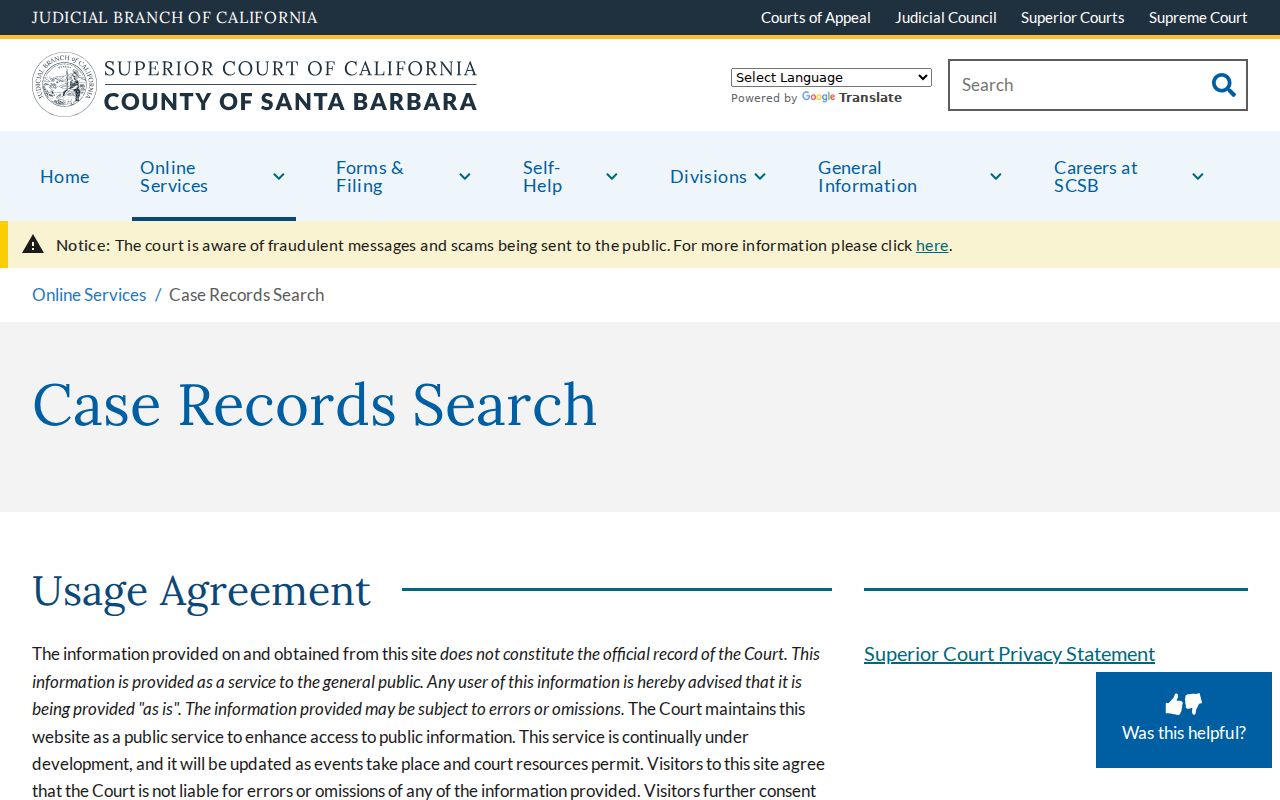
The landing screen is a gateway, not proof that every file or document can be viewed from home.
| Santa Maria court path | Records reached | Practical access | Key limit |
|---|---|---|---|
| Case Records Search | Public index where available | Online after agreement | Remote document limits |
| North County Records | Civil, family, probate, and copies | Counter, mail, or email request | Certified copies cannot be emailed |
| Miller Division lobby | Criminal and traffic records | Public terminal and records window | No online criminal index |
| Federal courts | Federal cases | PACER account | Federal access fees apply |
Santa Maria Criminal Search Goes Offline
The most important Santa Maria court exception is plain: there is no online criminal index. A criminal name search must move to a public terminal in the Miller, Figueroa, or Lompoc lobby, or to the proper copy-request process. Miller Division is the Santa Maria criminal and traffic location. North County Records is open from 8:00 a.m. to 3:00 p.m., while its published phone hours are 9:00 a.m. to noon.
Copies may be requested in person, by mail, or by email. Court copies cost $0.50 per page. A general certification costs $40 plus page charges, and a certified divorce judgment costs $15 plus pages. A search taking more than ten minutes may carry a $15 charge. Certified documents cannot be delivered by email.
Note: Bring the case number when possible, since it is more reliable than a common name and speeds the records request.
Santa Maria Vital Records Paths
The Santa Barbara County Clerk-Recorder holds county births and deaths from 1850 to the present and marriages when the license was issued in the county during that span. California Department of Public Health Vital Records is the statewide alternative. Divorce files and judgments are court records, not Clerk-Recorder certificates, so Santa Maria divorces finalized in the county go through Superior Court.
California Health and Safety Code section 103526 separates authorized and informational certified copies. An eligible person seeking an authorized copy must provide the required sworn statement. Other requesters may receive an informational certified copy that cannot establish identity. The county charges $34 for birth, $26 for death, $23 for fetal death, and $19 for marriage records under the fee schedule effective January 1, 2026.
The web order begins the process but does not finish an authorized request. The requester must appear in person or print the application, complete the notarized portions, and return it by mail or fax. Informational requests also require an in-person appearance or a signed form returned by mail or fax. Email is not accepted. Historical family research can add obituary notices, cemetery sources, yearbooks, and newspaper microfilm without implying that sealed or restricted certificates are open.
Note: California uses copy eligibility rather than a simple rule that every birth or death record opens after a fixed number of years.
Santa Maria Library People Search
The Santa Maria Public Library fills gaps that a current government index cannot. Its second-floor Special Collections area holds city directories, telephone books, high school yearbooks, local photographs, and regional newspaper microfilm reaching back to 1882. More than 800 genealogy titles cover regions, ethnic backgrounds, census sources, church records, military records, and passenger lists. Ancestry Library Edition is available onsite.
The most useful human service is the free Santa Maria Times obituary-copy request. Send the Reference Department the deceased person's name, a death date or a two-week range, and a return address or preferred email. Requests are limited to three items at one time and handled in order. An obituary can name relatives, former communities, clubs, schools, and funeral arrangements, which can then be checked against probate and recorder records.
For a former classmate or an heir search, pair a yearbook or obituary with a dated address from a city directory. The local trail is stronger when each source agrees on time and place. The library also provides Luna photographs, including the Allan Hancock Collection and Minerva Club Yearbooks, while staff at the Information Desk can point to material that is not digitized.
Note: The library confirms the collection types, but its official page does not publish complete year ranges for every city directory or telephone book.
Trace Santa Maria Property Records
Property identity is split among three tools. The recorder is name-first and ties grantors and grantees to recorded documents. The assessor is address-first or APN-first and returns parcel details, assessed values, value notices, and map access. County GIS is geography-first. It shows parcels and layers, but the public data removes owners and mailing addresses. No single portal performs all three roles.
An old address can still rebuild a Santa Maria trail. Search the assessor by house number, unit, and a partial street name without the suffix. Save the APN and check the assessor map. Use the recorder for deeds and related filings. For transfers from 1931 through 1975, search the separate historical grantor or grantee books and record the book and page. Then check library city directories and telephone books for occupants who may never have held title.
Permit data adds another layer. Santa Barbara County Accela accepts address, parcel, or permit information for active planning and building cases. A result may connect a site with an applicant, contractor, or project contact when those fields are public. Treat assessor maps as tax-reference maps, not legal surveys.
Santa Maria Business License Search
A business-related Santa Maria people search should move from local to state records. The city Finance Division handles business licenses, but the researched city page does not expose an open license register. A specific record may require a city request. County fictitious business name filings can connect a trade name with registrants, while California Secretary of State business filings may show an entity number, status, agent for service, addresses, managers, officers, and filing documents.
Professional work requires the board that issued the credential. The California Department of Consumer Affairs search covers many regulated boards and may show a license as current, expired, suspended, or revoked. Separate official tools serve contractors, attorneys, real-estate licensees, teachers, health professionals, and other fields. Match the full name with city, license type, and license number where possible.
The California DCA advanced license search supplies one of the official statewide starting points.
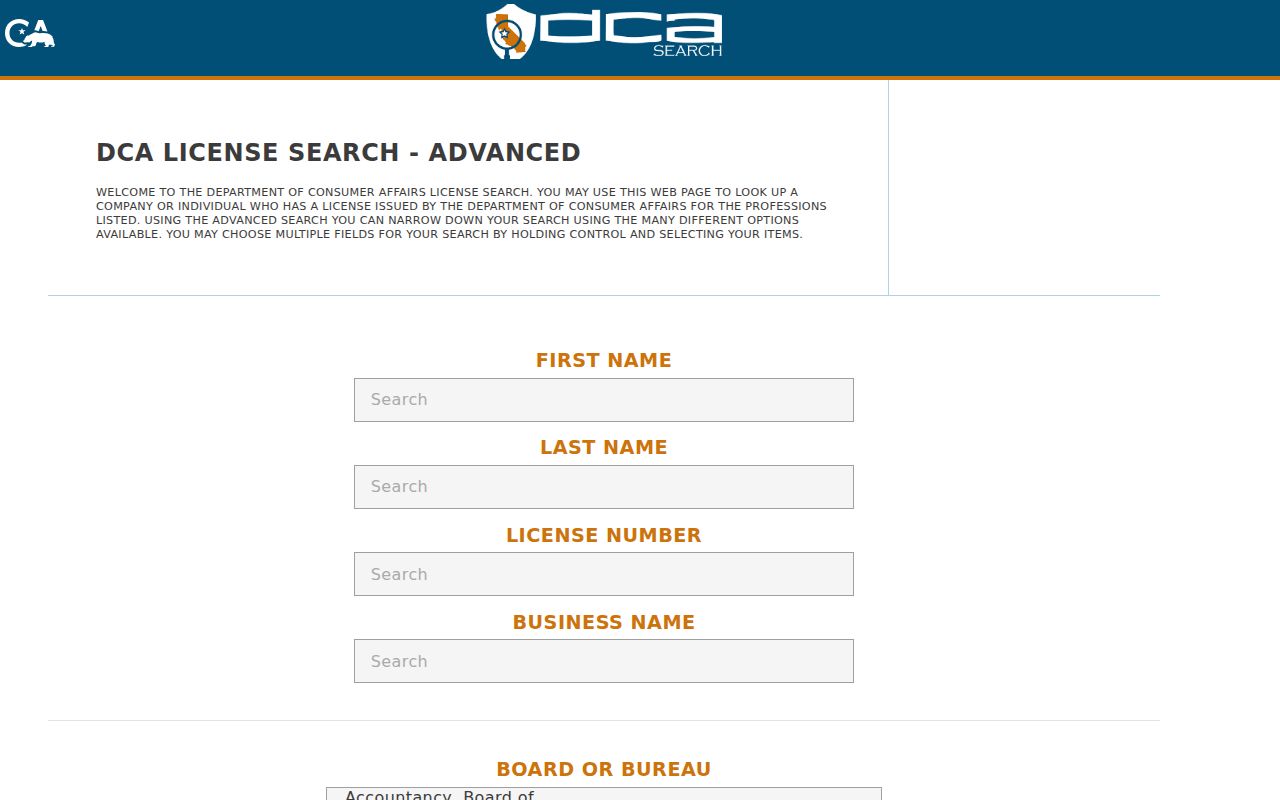
The advanced form helps separate people with the same name by board, license type, number, and location rather than relying on a loose name match.
Santa Maria Custody Records Search
The Santa Barbara County Sheriff Who Is In Custody tool searches by first name, last name, or inmate number, also called a CID. Results may include custody location, charges, status, and CID. The Northern Branch Jail at 2301 Black Road serves the Santa Maria area. This is a current-custody lookup, not a complete criminal history, and the Sheriff warns against relying on the data for legal action.
California prison custody is separate. CDCR's statewide incarcerated-person search reports current state custody information such as name, CDCR number, age, location, commitment counties, admission date, and parole-hearing information when applicable. The California DOJ registry is another distinct system with strict use warnings under Penal Code section 290.46. Never use any custody or registry result to threaten, shame, stalk, or harass a person.
A case file, jail roster entry, and state custody record answer different questions. Confirm the custodian, date, and status before drawing a conclusion.
Santa Maria Voter Lookup Boundaries
California My Voter Status is a self-check, not an open resident directory. A voter may confirm registration status, registration location, party and language preferences, ballot status, polling place, election materials, and voting history where available. Santa Barbara County Elections maintains the county records and links to registration verification and data requests.
The broader voter file is restricted. California allows requests only for approved election, scholarly, journalistic, political, or governmental purposes. An applicant must supply an original signature, identification, purpose documents, and the proper fee. Confidential voters and preregistration records for minors are excluded. Harassment, commercial use, unauthorized transfer, and leaving voter data unsecured are prohibited.
The official California My Voter Status page is the appropriate place for an individual registration check.
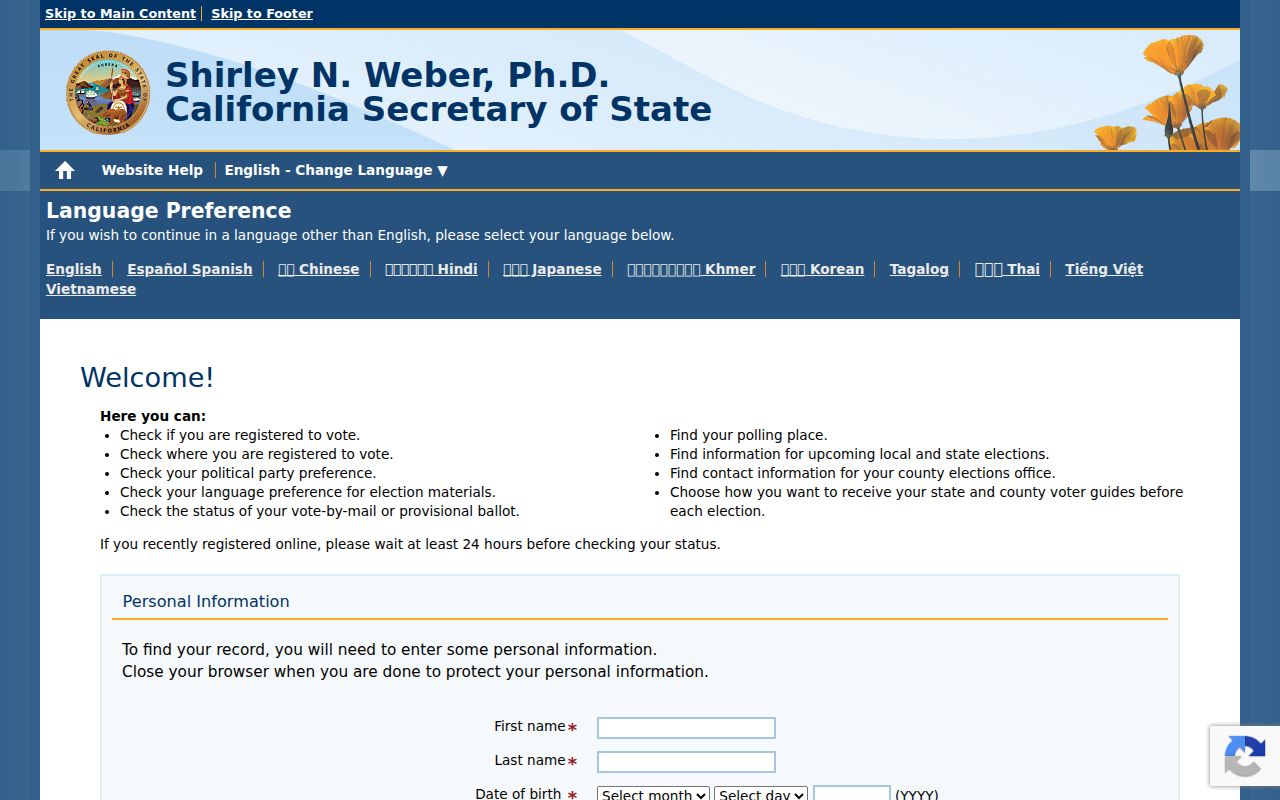
The lookup's official purpose is personal voter information, not a name-by-name search of Santa Maria residents. The full voter process is covered in the Santa Maria voter records resource.
Note: Santa Maria Elections Office access can change with the election cycle, so verify the current county listing before an in-person visit.
Santa Maria Search Privacy Options
Open records do not erase privacy protections. California Safe at Home supplies a substitute mailing address for eligible people facing safety risks, including survivors of stalking, domestic violence, sexual assault, trafficking, child abduction, and other covered harms. Confidential voter provisions keep protected registrations out of voter information files. Courts may seal files, and vital copies follow statutory eligibility rules.
California also regulates registered data brokers. The state's Delete Request and Opt-out Platform, known as DROP, began accepting consumer deletion requests in January 2026. Covered brokers must begin checking DROP at least every 45 days starting August 1, 2026, subject to applicable exemptions. This process addresses broker-held data, not the lawful source record kept by a court, recorder, or other government custodian.
When a public record exposes sensitive information, contact the office that holds it to ask whether a redaction, confidential status, correction, or statutory protection applies. Do not assume that deleting a broker profile changes an official filing.
Rebuild Santa Maria Historical Records
Santa Maria's older people records span several eras and formats. Santa Barbara County's Clerk-Recorder maintains real-estate and vital material back to 1850 and recorded maps from 1850 forward. County government minutes survive in handwritten books from 1850 through 1907. A recently digitized Water Claims Book covers 1877 through 1918, an unusually useful source for named claimants tied to Santa Maria Valley land and water.
The recorder trail then splits again. Historical grantor and grantee books cover 1931 through 1958 and 1959 through 1975, with scanned pages and raw OCR. The modern self-service index handles current work and reports a wider indexed date range on its search screen. A researcher may need the scanned book to find a book and page, a lobby terminal to see the image, and a copy order to keep the document.
Place names help decode the record. Main and Broadway marked the Four Corners at the start of the Central City townsite, and the Pacific Coast Railway arrived near West Main and Depot in 1882. Old directories and newspapers may use those landmarks or neighborhood terms rather than a present-day parcel description. Pair them with the library's microfilm, yearbooks, obituaries, and telephone books, then test each name against the recorder or probate index.
History work is rarely one-click. In Santa Maria, the shift from handwritten minutes to scanned index books, web forms, and privacy-trimmed maps explains why a careful people search still moves between archives, screens, and public counters.