
Santa Maria Records at a Glance
Most Santa Maria public records are county records, even when the person, parcel, or event is in the city. Santa Barbara County is the custodian for recorded land documents, county vital events, parcel assessment data, elections files, and the sheriff roster. The Superior Court controls its own case files. The city is the right keeper only for records made or held by Santa Maria departments.
| Record group | Keeper | Web starting point | Practical access |
|---|---|---|---|
| Deeds, liens, maps, FBN filings | County Clerk-Recorder | Official Records and Historical indexes | Free index; lobby image viewing; copy order |
| Civil, probate, family, traffic, criminal | Santa Barbara Superior Court | Case search where remotely allowed | Web, lobby terminal, or copy request; no online criminal index |
| Parcels, values, assessor maps | County Assessor | Parcel Details lookup | Free APN or address search |
| Birth, death, fetal death, marriage | County Clerk-Recorder or CDPH | Copy-order start | Eligibility rules; in person, mail, or fax |
| City council, contracts, maps, local permits | Santa Maria City Clerk or department | City request page | Online request; police channel is separate |
| Current jail custody | County Sheriff | Who Is In Custody | Free name or CID search |
Open does not mean unrestricted. Sealed cases, juvenile and adoption files, protected addresses, confidential voter files, some police investigations, and sensitive personal data can be withheld. Vital certificates use an authorized-copy and informational-copy system rather than a simple rule that old records are public and recent ones are closed.
Santa Maria Recorder Search Channels
The Santa Barbara County Official Records Search is the main name-based route for deeds, liens, maps, and other recorded instruments. The county describes its modern real-estate index as post-1975, while the self-service search screen states that indexed documents run from January 1, 1900 through its current update. For 1931 through 1974, the county also points to a separate historical index. Those statements describe different search surfaces, so date and record type should determine which path to use.
The standard name form expects an individual surname first. A broad search can use a surname and first initial. Advanced search separates grantor, the party transferring an interest, from grantee, the party receiving it. Staff do not search for the public. When a web result identifies the document but does not supply the image needed, Santa Maria and Santa Barbara lobby computers offer image viewing, and copies can be ordered through the recorder cart.
| Recorder field | Input type | Required? | Use and format |
|---|---|---|---|
| Name | Text | No | Enter individuals last name first; spell organizations as filed |
| Recording date start/end | Date | No | Narrows a current-index search |
| Document number | Text | No | Four-digit year, hyphen, seven-digit number |
| Both names | Text | No | Searches either party side |
| Grantor / grantee | Text | No | Limits by transfer role |
| Document types | Selection | No | Filters by recorded instrument type |
Note: Document copy orders are processed within 10 business days; certified copies are mailed, while regular copies may qualify for email delivery after a timely help-desk message.
Santa Maria Historical Records Index
The county-endorsed historical system divides its scanned grantor and grantee books into 1931-1958 and 1959-1975 spans. Users choose a party role, individual or corporation, time frame, and name. Search a last name or business name, then inspect the matching alpha group. Entries within that group follow recording date, not strict alphabetical order. Extremely common names may sit in a “Special Names” group.
The official Santa Barbara County Historical Index shows this scanned-book and OCR route:
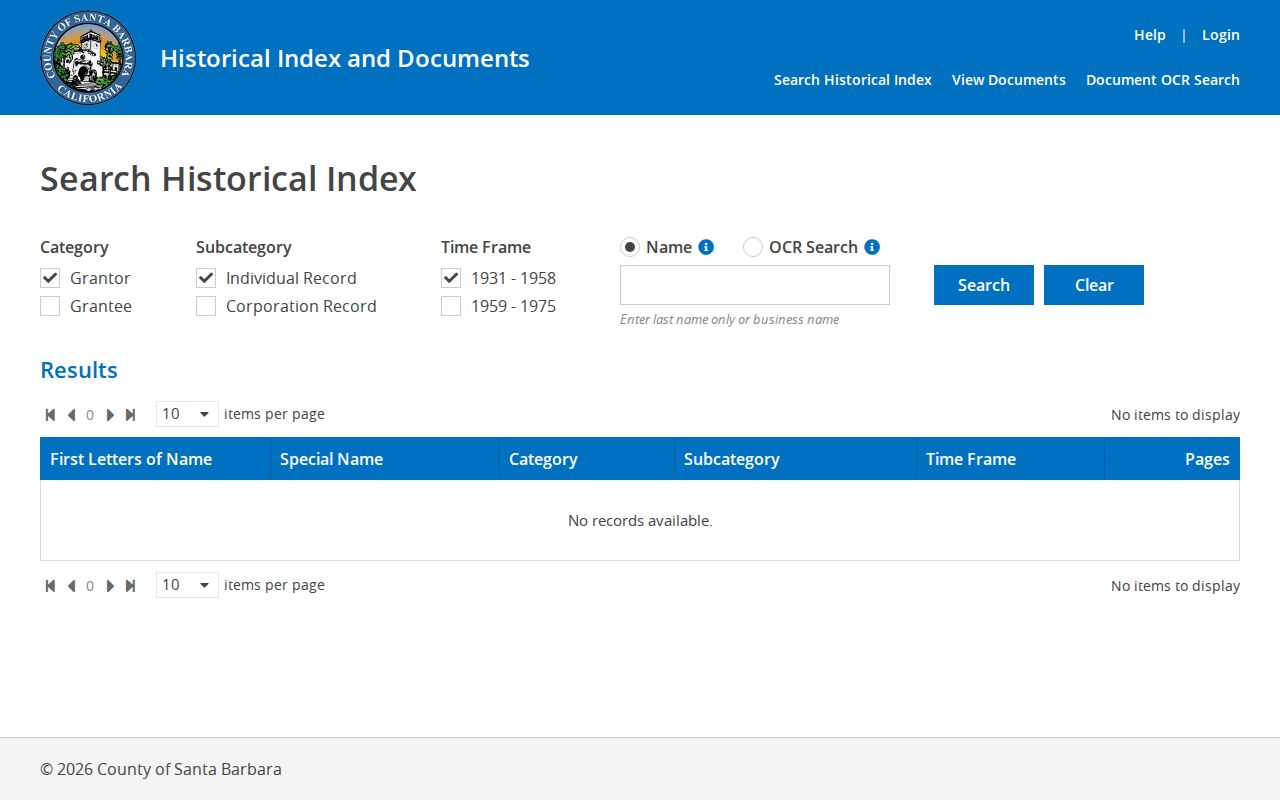
The search may yield a book and page rather than the underlying deed image. Save both values, since the lobby or copy desk needs them to retrieve the document. OCR text is raw and unverified, so the scanned page controls when spelling or placement differs. This two-stage process is slower, but it preserves access to a crucial part of Santa Maria's recorded land history.
Santa Maria Property Records Divide
Property evidence is split among three county systems. The recorder is name-first and shows parties to recorded documents. The assessor is parcel-first or address-first and returns parcel details, assessed values, value notices, and assessor maps. The county GIS is geography-first. Its public parcel layer removes owner names and mailing addresses, so it cannot replace the recorder as an owner-linked index.
The Assessor Parcel Details lookup accepts a parcel number or house number, unit, and street name. When an address fails, use part of the street name and omit suffixes such as Street, Avenue, or Boulevard. The parcel map search requires numeric book and page values with leading zeros. Those maps are tax-reference tools, not legal surveys.
The county's public GIS still helps determine whether a Santa Maria mailing address is inside city limits, in nearby Orcutt, or in an unincorporated service area. That distinction directs a permit or administrative request to the right office. A situs address means the physical site; an owner mailing address is where tax mail goes and may be different.
Santa Maria Court Records Channels
Santa Barbara Superior Court starts remote access with a usage agreement and applies California Rules of Court 2.503 to document display. A case number is the strongest search key. Civil, probate, family, and calendar information may be available online, but remote access varies by case class. Confidential or sealed files remain limited, and the court will not confirm a person's birth date, partial Social Security number, address, or driver license number by phone or email.
Criminal access is the local exception. There is no online criminal index. Searchers must use the Records window or a public terminal in the Figueroa, Miller, or Lompoc lobby. The Miller Division is the Santa Maria criminal and traffic point. Treat a name match as a lead, not proof of identity, and compare the case number, filing date, party role, and division.
The Superior Court records request page lays out the terminal, request, and fee channels:
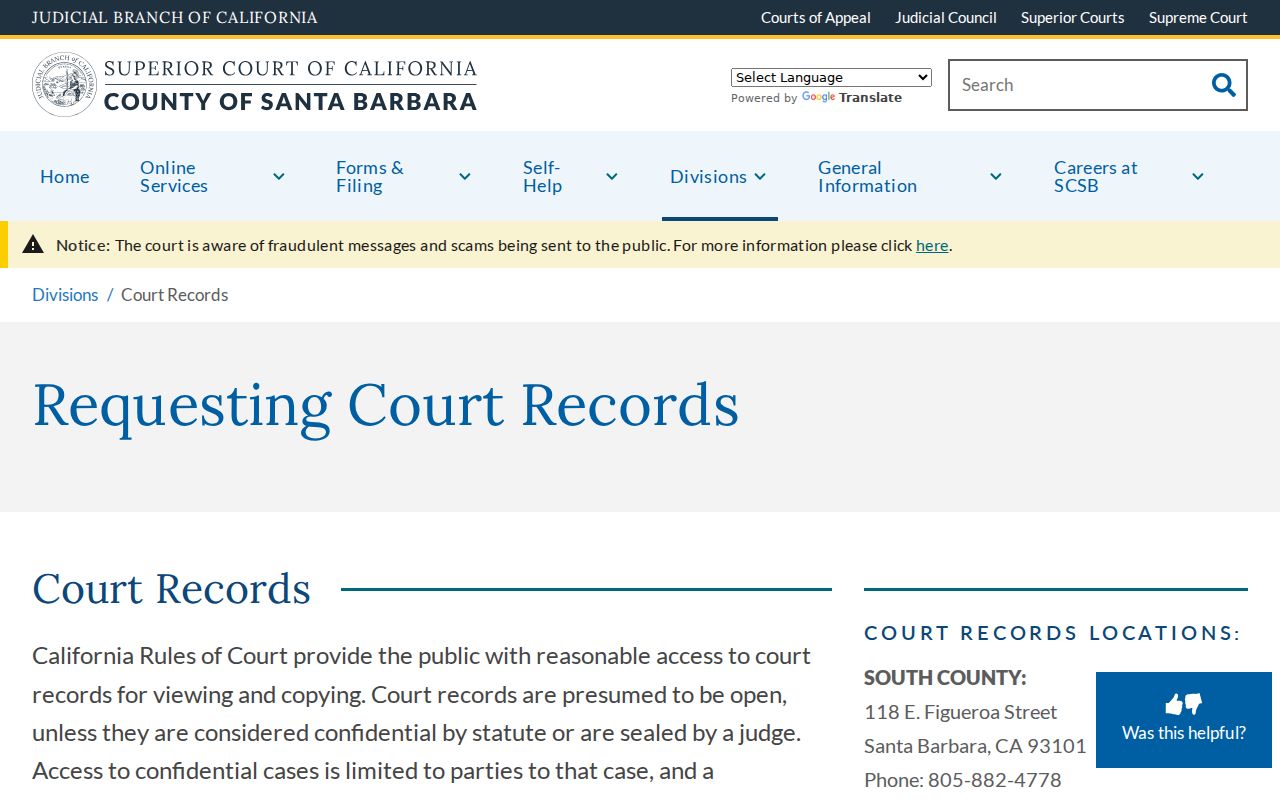
Copies may be requested in person, by mail, or by email, then held for pickup, mailed, or emailed when permitted. Certified documents cannot be emailed. The published fees include $0.50 per page, a $40 certification fee plus pages, a $15 certified divorce judgment fee plus pages, and $15 when a file search exceeds ten minutes.
Vital Records Copies for Santa Maria
Santa Barbara County holds births and deaths that occurred in the county from 1850 to the present, plus marriages licensed in the county over the same span. Divorce files and judgments belong to Superior Court, not the Clerk-Recorder. California Department of Public Health is the statewide copy channel and handles certain amendments.
Under Health and Safety Code §103526, only an authorized person may receive a certified copy that can establish identity. Other requesters may obtain a certified informational copy marked as invalid for identity. The county vital-record order system lists 2026 fees of $34 for birth, $26 for death, $23 for fetal death, and $19 for marriage.
The web step does not finish an authorized-copy request. The applicant must appear in person or print the application, complete the required sworn and notarized sections, and return it by mail or fax. Informational-copy applicants must appear or sign the specified box and return the form by mail or fax. Email is not accepted for either route.
Santa Maria Public Records Offices
North County service points spare many Santa Maria residents a trip to the county seat. The recorder offers a Santa Maria lobby computer route, the court has a local records desk, and the City Clerk receives municipal requests at City Hall. Check the linked office page before visiting because service details can change.
County Clerk-Recorder
Santa Maria and Santa Barbara lobby access
Deeds, vital copies, FBNs, marriages, archives
North County Court Records
312-E East Cook Street
Santa Maria, CA 93454
805-614-6414
The court desk publishes both office and phone hours, while the City Clerk publishes a rotating-Friday schedule. Recorder image access depends on the lobby computers because staff cannot perform a document search for a requester. Calling ahead is most useful for confirming the right counter and current service window, not for asking staff to identify a person.
Santa Maria Custody Records
The Santa Barbara County Sheriff's Who Is In Custody search accepts first name, last name, or inmate CID number. Results can show custody location, charges, status, and CID. The Northern Branch Jail at 2301 Black Road is the Santa Maria-area county facility. Custody data describes a current jail status, not a complete criminal history, and the sheriff warns against relying on it for legal action.
State prison custody is separate. California's CIRIS service covers people currently in CDCR custody and can return a name, CDCR number, age, location, commitment county, admission date, and parole-hearing details. The California DOJ registry is another distinct state system with strict Penal Code §290.46 use limits. None of these replaces a court case file.
Santa Maria City Records Requests
Use the city channel for records that Santa Maria created or keeps: council files, ordinances, municipal code material, city contracts, maps, business-license administration, and permits handled by city departments. Do not send deed, county vital, superior court, elections, or assessor requests to City Hall. Those belong to county or court custodians.
The Santa Maria request page separates police records from all other municipal files. Non-police requests go through the City Clerk's public-records route. Police requests use the listed email channel, and investigative or privacy exemptions may limit release. City Clerk hours are Monday through Thursday, 8:00 a.m. to 5:00 p.m., and alternating Fridays, 8:00 a.m. to 4:00 p.m.
Fees follow the city's 2025 User Fee Schedule and the CPRA rule for actual reproduction cost. A focused request should state the department, record type, subject, address or project number if known, and a useful date span. Broad wording can make responsive files harder to identify.
Requesting Santa Maria Public Records
The California Public Records Act, Government Code §7920.000 and following, lets any person ask a state or local agency to inspect or copy disclosable records. The agency generally has ten calendar days to determine whether responsive, disclosable material exists. Unusual circumstances can support a fourteen-day extension. That determination period is not a promise that all copies will be ready in ten days.
- Name the custodian. Choose Santa Maria, Santa Barbara County, the court, or a state agency based on who made or keeps the record.
- Check the existing index. A document number, case number, APN, date, or department can make the request far more exact.
- Describe the record. State the subject, date range, known names, and preferred electronic or paper form without asking the office to answer a broad question.
- Use the office's channel. Submit through its portal, email, mail, fax, or counter as that record system requires.
- Review the response. If records are withheld, read the cited exemption, narrow the scope when useful, and ask the office to segregate releasable portions.
The California Secretary of State CPRA overview explains that ordinary fees generally cover duplication or direct production cost, not staff research time unless another statute authorizes a charge. Court, recorder, and vital-copy fee statutes remain separate.
Lawful personal use. Use Santa Maria public records for lawful family, estate, civic, property, safety, or consumer research. Never use a record to stalk, harass, threaten, or expose a protected person.
Santa Maria Records Terms
Different offices use the same words in precise ways. Knowing them prevents a request for the wrong product and helps explain why a free search result is not the same as an official copy.
- Index
- A finding tool with names, dates, and document references. It may not include the record image.
- Certified copy
- A copy bearing the custodian's formal certification. It often has a separate fee and delivery rule.
- Custodian
- The agency or office that maintains the record and decides access under the governing law.
- Exemption
- A legal basis allowing or requiring an agency to withhold all or part of a record.
- APN
- The assessor parcel number used to identify land in tax and map systems.
A recorder index entry can therefore be free to locate while the image or certified copy carries a fee. Likewise, an assessor map may help find the APN but cannot settle a boundary dispute. Use each item for the limited job its custodian describes.
Santa Maria Records Privacy Lines
California access law sits beside strong privacy rules. Safe at Home, governed by Government Code §§6205-6216, provides a substitute mailing address for eligible people facing safety risks. Confidential voter status also keeps protected registration data out of voter files. The county GIS parcel layer takes a different approach by omitting owners and mailing addresses from its public open-data release.
The Safe at Home program explains its protected-address process. Searchers should not try to defeat a confidentiality measure by piecing together a residential address from other files. A redaction or missing field may be an intentional legal boundary, not a portal error.
Note: Court-sealed, juvenile, adoption, protected-address, confidential-voter, and certain investigatory records remain restricted even when related index entries or agency logs are open.
North County Records Geography
Santa Maria is not the county seat, yet it functions as the main North County service center. That geography changes how records are obtained. Court records have a local East Cook Street desk and Miller lobby terminal. County custody has the Northern Branch Jail. Elections may operate a Santa Maria office on an election-cycle schedule, while Clerk-Recorder lobby access gives North County users a route to recorded document images.
Jurisdiction still matters more than the mailing city. A Santa Maria ZIP can cover an address in the city, in Orcutt, or in unincorporated county territory. City maps and county parcel geography help identify the right permit or administrative custodian. For a local government record, verify the boundary first. For deeds, court files, vital copies, county custody, and assessment data, begin with the county or court regardless of the street's city label.
Early Santa Maria Records Trail
Santa Barbara County's handwritten board-minute books span 1850 through 1907. They capture early officials, petitioners, road matters, appointments, licenses, and claims that may not appear in a modern person index. The Clerk-Recorder archives also maintain real estate and vital material back to 1850, recorded maps from 1850 forward, and a digitized Water Claims Book covering 1877 through 1918.
These sources are especially useful for Santa Maria Valley land, ranch, farming, and water history. Early records can preserve a name that later indexes spell differently. The recorder's scanned books, archive material, and county minutes should therefore be treated as complementary systems. For family or heir research, a historical entry can then be checked against probate files, old newspapers, and library-held directories without assuming that every early county record has been converted into a web-searchable name.